
Topaz and Medieval Gemstones

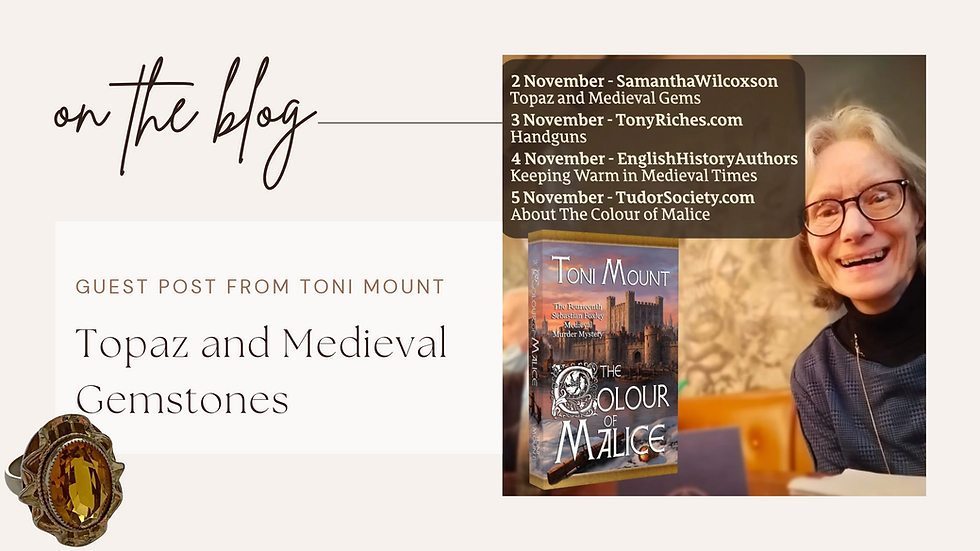
Hello, dear readers! You may recall that I recently shared my review of Toni Mount's latest Sebastian Foxley novel, The Colour of Malice. I am happy to welcome her to the blog today with some interesting historical background to that story.
Samantha
~~~~~~~~~~~~~~~~~~~~~~~~~
Topaz and Medieval Gemstones
Guest Post by Toni Mount
In The Colour of Malice, the latest murder mystery in the Sebastian Foxley series, set in London in the winter of 1482, Leo Fairbrook possess an enigmatic topaz ring but how did he come by it? This is critical to the story but the jewel, topaz, has tales to tell of its own.
The history of topaz spans thousands of years and features royal treasures, ancient myths and numerous cases of mistaken identities. Without modern science, true topaz was often confused with other gems, such as peridot, yellow garnet and citrine. The word ‘topaz’ probably comes from the ancient Sanskrit word tapas, meaning ‘fire’ but another idea traces the word’s origin to Topazos, or Topaz Island in the Red Sea which, even today, is mysterious and not to be visited, being an Egyptian militarised zone. The island was an ancient source of yellow-green gemstones but these were peridot, not topaz.
The Ancient Egyptians believed yellow topaz got its golden colour from Ra, their Sun God, and wore the stone as a powerful amulet to invoke Ra to protect them from harm. Greek and Roman warriors believed topaz gave them physical strength and was capable of making the wearer invisible if danger threatened. For non-military Romans, topaz was particularly effective at warding off trouble while travelling.
During the Middle Ages in Europe, it was believed that wearing a topaz on the left arm protected the owner from any curse and turned aside the evil eye. Medicinally, it was thought that topaz increased body heat to relieve colds and chills and also cured lunacy by enhancing mental powers. In India, people believed topaz granted beauty, intelligence and longevity when worn over the heart.
With so many marvellous virtues accredited to topaz in the medieval period, the truth is that the name was used to refer to any yellow gemstone. For example, translations of the Bible refer to topaz but, in this case, the yellow stone is most likely peridot, not a true topaz.
For centuries, topaz was a luxury reserved mostly for kings, queens and high status churchmen, used in decorative jewellery. Due to its association with purity and goodness, it was favoured by cardinals and bishops in their ceremonial rings. Pope Innocent III (1198-1216) sent Richard the Lionheart four gold rings, each set with a different symbolic stone. The accompanying letter informed the king that the emerald ring signified how we should believe, the celestial purity of the sapphire how we should hope, the warm colour of garnet how we should love and the clear transparency of topaz how we should act.
The mention in the papal letter of garnet and topaz raises an interesting connection between these two gemstones. Topaz is a hard, slippery-surfaced stone in its own right but quite rare. However, a particular type of garnet is a definite contender for the gem in Leo Fairbrook’s ring and probably other medieval royal jewels. We know that red garnets came to Europe from as far away as Sri Lanka (formerly Ceylon) even in ancient times, including some of those exquisite and intricately worked garnets in the Anglo-Saxon Sutton Hoo treasure. But also found in Sri Lanka are ‘hessonite’ garnets. The origin of their discovery is shrouded in mystery but they have been unearthed there for thousands of years with their history dating back to traditional folklore and early trade. They were sometimes called ‘cinnamon stones’ because the cinnamon spice was traded along with these garnets which varied in colour from lemon to golden yellow and warm chestnut shades. In medieval England, cinnamon was a luxury import and perhaps these ‘hessonite’ garnets were too – and termed ‘topaz’. We know they were used for jewellery and religious decoration. While these beautiful golden stones have been mined there for thousands of years, new deposits continue to be found in Sri Lanka.

So garnets and peridots were mistaken for or simply called ‘topaz’ but topaz itself could masquerade as other gems. During the sixteenth century, a colourless form of topaz was effectively used in place of diamonds by Renaissance jewellers being almost as hard as diamond and capable of refracting light in a similar way.
To discover how this intriguing jewel causes so much trouble in London in 1482, join Seb Foxley, his family and friends in his new adventure, The Colour of Malice, from author Toni Mount, published by MadeGlobal.

Winter, 1482. A strange new weapon has appeared on the frozen streets of medieval London. Few have seen its like before. Sadly, someone has already learned how deadly it can be, and artist, scribe and sometime sleuth Sebastian Foxley must investigate this new murder mystery.
Seb's search for answers takes him from London's humble fisherfolk to the court of Richard, Duke of Gloucester, where he has been commanded to paint a portrait of the Duchess, Anne Neville.
But perhaps the deaths are not the work of a stranger. An enemy from Seb's past has returned, bringing old malice and new danger to the city. With London gripped by bitter cold, Seb must discover who is behind the killings and what they really want before another victim pays the ultimate price.
Join Seb, his family and friends in The Colour of Malice, the fourteenth Sebastian Foxley Medieval Murder Mystery, as secrets are uncovered and murder comes again to the stinking streets of medieval London.
About Toni Mount
Toni Mount earned her Master’s Degree as a mature student at the University of Kent by completing original research into a unique 15th-century medical manuscript.
She is the author of several successful non-fiction books including the number one bestsellers, Everyday Life in Medieval London and How to Survive in Medieval England, which reflect her detailed knowledge of the lives of ordinary people in the Middle Ages.
Toni’s enthusiastic understanding of the period allows her to create accurate, atmospheric settings and realistic characters for her Sebastian Foxley medieval murder mysteries.
Toni’s first career was as a scientist and this brings an extra dimension to her novels. She writes regularly for The Richard III Society’s Ricardian Bulletin and a variety of history blogs and is a major contributor to MedievalCourses.com.
As well as writing, Toni teaches history to adults, is an enthusiastic member of two creative writing groups and is a popular speaker to groups and societies.
This is the fourteenth novel in Toni’s popular Sebastian Foxley murder mystery series.
Connect with Toni on Facebook.



Comments