_edited.jpg)
Death by Lightning

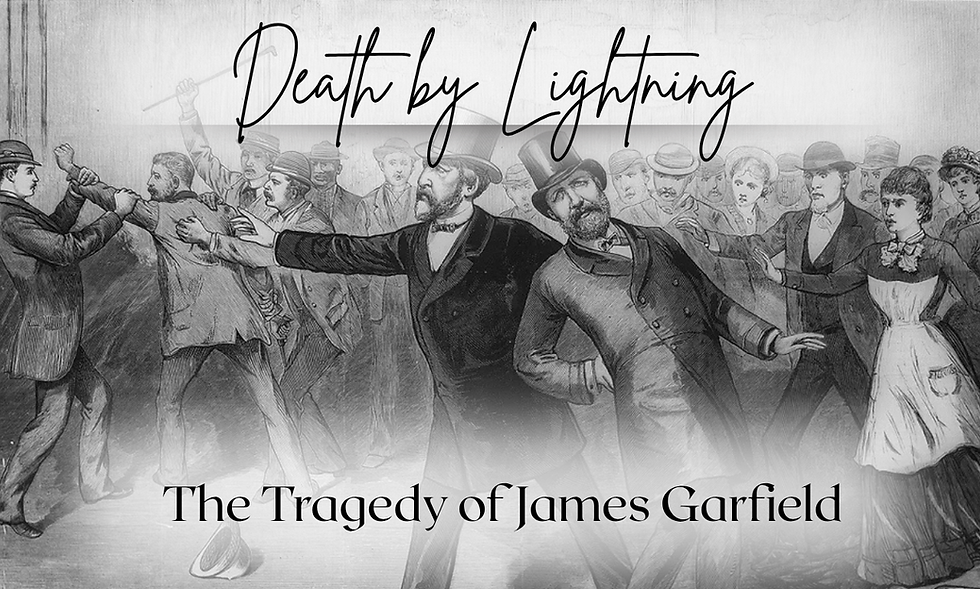
Several years ago, I read a book that has always stayed with me. Candice Millard's Destiny of the Republic remains to this day the most gripping work of nonfiction that I have ever read. James Garfield, a man I knew little about before picking up Millard's book, was astonishingly inspiring, and his treatment, first by his assassin and then by his incompetent physicians, was horrific almost beyond belief.
When I saw that Netflix was releasing a limited series based on Destiny of the Republic, I couldn't wait to watch, though I hoped they would give the book, and President Garfield, their due. In the first episodes, we see Garfield's rise, but steal yourself for his gory, tragic end.
I absolutely love the story of the 1880 Republican Convention. Sounds crazy? Stay with me.

Garfield shows up to nominate John Sherman, brother of the General Sherman you're probably thinking of who "marched to the sea" with his army during the Civil War. Both are reformers with hopes to restore the Republican party to the ideals of Lincoln and root out corruption, which has flourished under Grant's well-meaning but shockingly naïve administration. (Hayes was also in there, but we're just gonna skip over him for today because he was not running for a second term.) The Netflix series dramatized this part really well.
Michael Shannon, playing James Garfield, gives a rousing speech in all its 19th century glory. Unfortunately, he doesn't mention poor Sherman's name until the very end, and a few people have noticed that Garfield might be just the man they need rather than the one he's suggesting. When he gets a single vote in the first round, Garfield gazes around in wonder and objects that he cannot receive votes without his consent. Power players like James Blaine and Roscoe Conklin are just as bewildered as Garfield (but much angrier) when his vote count keeps increasing despite his objections.
It's fantastic. Watching a morally upright man who wants what is best for his country but not the presidency for himself get the nomination over greedy, self-serving career politicians - what I wouldn't do for a modern replay of that. It's a wonderful historical moment, and it was fun to watch it portrayed on screen.

Where does the show fall short? Not in the beard and sideburns department, that's for sure. The costuming and dialog are fantastic, and I recognized many of Shannon's lines as quotes directly from Garfield.
The producers took advantage of the fact that Charles Guiteau, Garfield's top fan turned assassin, spent time in a free love community. They interpreted this to mean people having sex in public and in a dormitory with a different couple on each bunk. Um ok, even if that was true, I definitely didn't need to see it, but it wouldn't be onscreen in 2025 without some gratuitous sex.
I will only point out one more thing that they don't mention that I think would add to the historical context. Much is made of the corruption of certain people, chiefly Conklin, within the Republican party. This was true, but what the viewers miss is that it was a shady time for politics in general. Democrats were still recovering from the Civil War where they had been the party of slavery and secession and had only gained power in the South in 1880 through KKK terrorism. This is why Garfield stands out so much. Politics had become dangerous and violent. This little known "Man from Ohio" was a voice that reminded people of Abraham Lincoln, who had such an enlightened vision for the country's future before he was killed by Southern white supremacist, John Wilkes Booth.

Those points aside, I heartily recommend watching Death by Lighting (this title is taken from a Garfield quote, as is Millard's Destiny of the Republic - such a quotable guy!)
The final episode features Garfield's assassination, which is as frustrating and heartbreaking I anticipated, but not in the excruciating (but well worth reading) detail included in the book. Throughout Garfield's unnecessary suffering at the hands of his doctors, he maintained his stoic, faithful demeanor in Millard's telling, but the show glosses over it somewhat. The fact that he would have been just fine if they would have simply left him untreated is an underappreciated tragedy in US history, and I think the show at least gets that point across.
I would have preferred a bit more focus on Garfield and less on Guiteau, but overall I was very happy with the show. Are you watching? Let me know what you think!



Comments